CASE STUDY

FITZ ROLL

A bit of order to the chaos.

UX DESIGN
USER RESEARCH
INFORMATION ARCHITECTURE
VISUAL DESIGN
LETTERING

In Buenos Aires, more specifically in Palermo Hollywood, there is a small takeaway business that serves wraps and salads to go. This little shop became very popular amongst the abundance of startups and TV broadcasters that reside in the area. Their quality products, affordable prices and excellent attention are the reason why the shop is always full of customers.

During the lunch break it’s very common to see many people standing in a line to order their favorite option.

Word-of-mouth was the primary growth agent as people who try their products for the first time keep coming back and convert friends into Fitz Roll´s regulars as well.

THE BLACKBOARD MENU

Many of us –the early adopters– were the witnesses of its constant evolution.

Little by little, different parts of the customer journey were being improved: the way they took orders, the arrangement of the food service area for the most efficient preparation, and the delivery of their delicious products.

However there was an element that failed to evolve throughout the many iterations: the blackboard with the prices.

The old blackboard, with cluttered repetitive elements that increments the difficulty of the choice.

The blackboard with the menu is, in fact, the fundamental piece of communication for placing an order. Moreover, it is the perfect spot for brand association with the product.

I decided that I could share my knowledge redesigning it. Completely unsolicited,  I began to think about how I could resolve this problem “as a surprise”..

PROPOSE WITH PURPOSE: ANALYZE & SKETCH.

Analyzing the blackboard at a glance, I notice inconveniences that should be resolved:

LACK OF COLOR CODING

Creating a color system will enable customers choose faster.

BRAND ABSENCE

Placing the logo in the board will create awareness and memorability.

REPETITIVE ELEMENTS

Discarding redundant information will avoid cognitive overload.

POOR HIERARCHY

Highlighting most important products and anchoring them with icons will make them more recognizable.

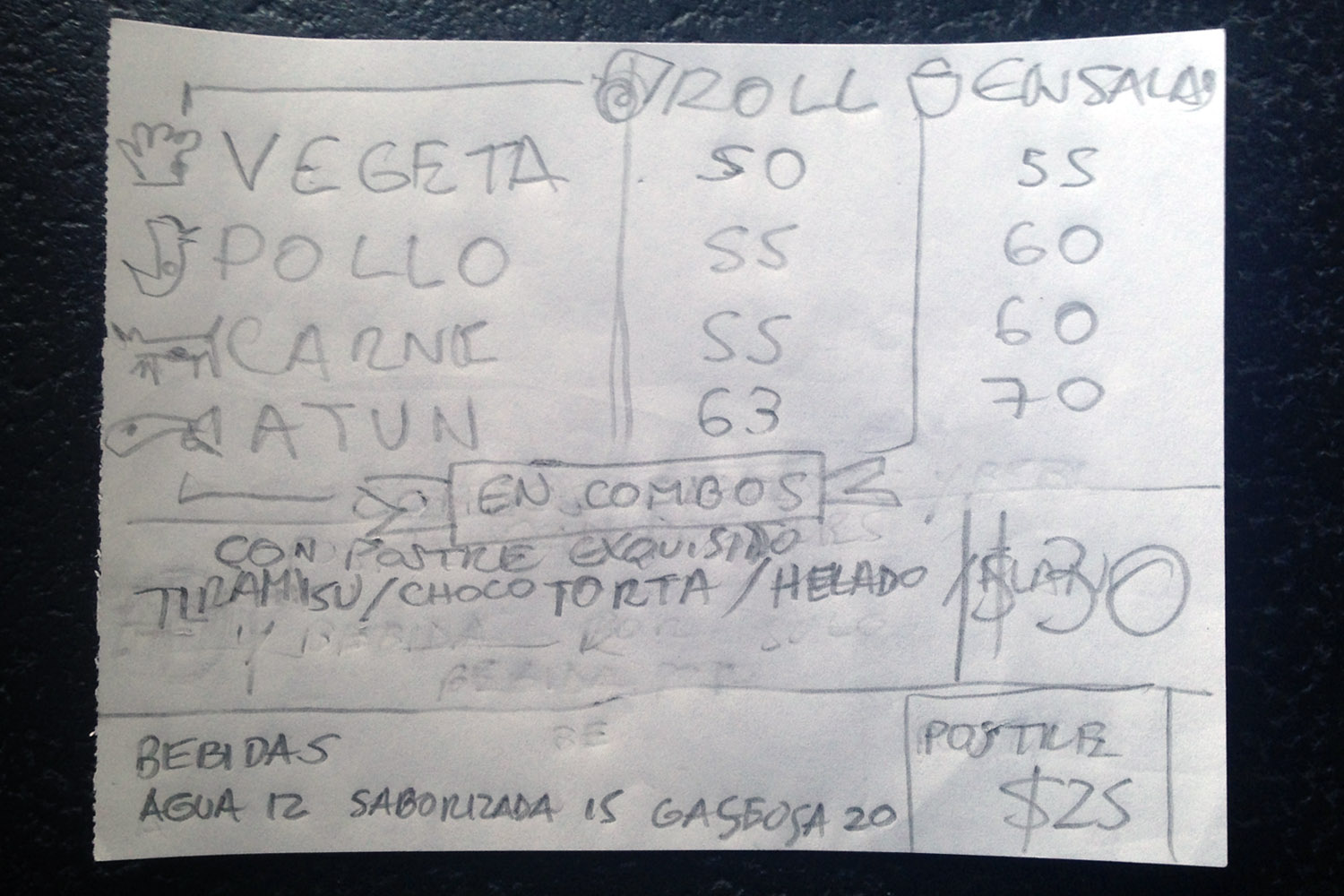
The most important thing was that the two hero products must be recognizable and easy to understand in terms of their variants and prices. I suggested restructuring the information in a table format with a visual hierarchy and iconic indicators. I went through two phases of exploration:

COLUMN BASED
PER INGREDIENT

This displaying way, initially seemed to be adequate but after analyzing the space, it turned out that the vertical layout led to a huge horizontal space misuse.

ROW BASED
PER PRODUCT

This distribution took advantage of 100% of the horizontal space, making a loose distribution of the remaining elements.

Based on these insights, I iterated upon the second proposal, putting all the elements in their final place:

The row based proposal resolved all of the inconveniences that were previously identified.

SELLING THE IDEA

The surprise came when I stopped by the shop and told them:

-“I have your new blackboard”, showing my draft with my conclusions.

-“I’m loving it” was the immediate answer.

We didn’t hesitate and got down to work:

PUTTING YOUR SHOULDER TO THE WHEEL

We started with dividing and creating the different spaces for the elements. This practice is very common when outlining the structure of a web page.

Finally, after an extensive yet funny workday full of lettering and painting, the result was surprising:

The New Blackboard. By using icons, colors and big numbers the decision making process was undoubtedly easier.

THE DAILY SPECIAL

Daily special products have predetermined ingredients which vary by day and are available for order without queuing and a minimal waiting time. They are promoted on a blackboard wall called “Del Día” that we created for this purpose.


The sign keeps the main elements fixed and others, like the ingredients were updated daily.

Using this blackboard, we realized that everything wasn’t a bed of roses. Rewriting ingredients everyday in a ‘chalk unfriendly’ surface was a painful, time consuming task.

LEARNING FROM MISTAKES

The key factor that led us to try a different approach was that the people waiting for their orders covered the blackboard unknowingly.

Having this insight in mind, we redesigned it again and changed its location from the wall to hanging from the ceiling, close to the other board.

Other important things were considered as well:

  • Using interchangeable ingredients will save time everyday.
  • The pre-written ingredients will maintain typography consistent across the boards.
  • Hanging board will improve the visibility and access of the daily special information.

People waiting for their orders made it difficult to see the daily special menu options, so we decided to relocate this menu instead.

MAGNETS BIATCH


The new “Del día” hanging board, with magnetic ingredients that allows a quick set up everyday.


Easy to visualize hanging menu boards decreased the decision-making time while queueing noticiably

Roll del Día

The envelope of the daily roll was white-clear at the beginning, missing a brand awareness opportunity.
To solve it, I created a basic stamp that fills that gap and can be used wherever they want.

Ensalada del Día

The daily salads are a quick and healthy lunch option.
Using fixed ingredients avoids personalizing them, which means fastest selling service.

THE BOTTLENECK:
TAKING THE ORDERS

Handwriting every order was one of the biggest point of congestion during the customer experience that led to long queues.


A nice first attempt, but the checkboxes were spaced too far from the ingredients, taking more time to decode it and increasing the preparation time.

A STAMP TO SPEED THINGS UP

Although the preparation process has speeded up a lot due to incorporation of the “fixed” menu of the day, there were still some factors that were slowing down the process of taking the orders, the major factor being the way of taking orders itself – writing down everything by hand!

This resulted into a constant delay that clearly reflected on the quantity of the people waiting in the queue.

To improve this part of the process, they decided to incorporate a special stamp that would allow them to “check the boxes” and so would save them a lot of writing.

The stamp was a clever move,  but the checkboxes were too far from the ingredients leading to preparation mistakes.

THERE’S ALWAYS ROOM FOR IMPROVEMENT

Taking into account the checkboxes insight, I made some adjustments and improvements and suggested an iteration on the existing form. I added some important details: the address, the brand, etc.

We used the empty space at the bottom as “call to action” for engagement in social media.

The envelope also leverages the improved two column layout on the stamp.

Ingredients were arranged in the same manner in the food preparation area as they were on the order form, speeding up the preparation.

RESULTS

We didn’t have to wait long to see the fruit of our labor: customers provided positive feedback immediately.

They found the form redesign highly useful as it sped up the ordering process. The readability and simplicity of the display boards were also widely praised by staff and consumers.

Spreading the identity across other strategic touchpoints like the delivery envelopes and order forms encouraged “word of mouth” advertising, making it easy for new customers to find out where the products come from.

The order form redesign encourages clients to participate in social conversations and thus serves as a starting point to build community and gather valuable feedback.

Being a witness of the evolution, the result were stunning not only in terms of user experience improvement, but as well in business franchise projections.

THE END

THIRSTY FOR MORE?

If you consider that we can work together

or back to Almacén Purista